Botox Training: Your Path to Certification
By Injectables EDU Editorial Team · Updated 2026-07-23
Botox certification requires licensed healthcare professionals—RNs, NPs, PAs, and physicians—to complete hands-on injectables training covering facial anatomy, dosage, and technique. Injectables EDU offers Botox and filler courses nationwide and online, with continuing education credit from AANP. Practice owners can also enroll staff to build in-house injectable expertise and expand aesthetic service offerings.
Key Takeaways
- Botox certification requires completion of intensive training courses conducted by experienced physician instructors in aesthetic medicine.
- Basic Botulinum Toxin Certification is offered as a comprehensive one-day course with hands-on practice; pricing varies by package, so contact Injectables EDU directly for current rates.
- Eligible candidates include registered nurses, nurse practitioners, physician assistants, and medical doctors seeking injectable administration credentials.
- Injectables EDU in Richmond, VA offers professional Botox training and certification programs for qualified healthcare practitioners.
What Do You Need Before You Start?
Licensure comes first. State and federal rules restrict Botox administration to physicians, physician assistants, nurse practitioners, and registered nurses working under proper medical direction. No amount of coursework substitutes for that credential. Before enrolling in any program, clinicians should confirm their license type qualifies them to inject in the states where they intend to practice, since scope-of-practice rules vary.
What credentials does a clinician need before enrolling?
An active, unrestricted nursing or medical license is the baseline requirement. Beyond licensure, a clinician needs a working knowledge of facial anatomy. Injection safety depends on understanding muscle groups, vascular structures, and danger zones before a needle ever touches skin.
What should a pre-training checklist include?
- Verify your active RN, NP, PA, or physician license in good standing.
- Confirm state-specific supervision or collaborative practice requirements.
- Review basic facial anatomy, including muscle layers and vascular landmarks.
- Select a botox training program that pairs didactic content with live-model practice.
- Plan for dosage, dilution, and complication-management instruction alongside injection technique.
Aesthetics training builds on that clinical foundation rather than replacing it. Coursework should cover patient selection, contraindications, and touch-up protocols, not just needle placement. Many nurses pursuing [nurse injector training](https://injectablesedu.com/botox-injection-training-for-nurses) also add [dermal filler training](https://injectablesedu.com/dermal-filler-course-training-for-nurses/) to their credentials, since practices increasingly expect injectors to offer both neuromodulators and fillers.
Injectables EDU, based in Richmond, VA, trains clinicians nationwide who want to know how to get trained in botox the right way. Hands-on instruction paired with mentorship helps nurses move from licensed professional to confident injector ready to launch an aesthetics side-hustle or practice.
How Do You Choose A Botox Training Course?
Course quality depends on three factors: curriculum depth, class size, and hands-on access. Licensed professionals evaluating botox training should weigh these factors before enrolling. Not every program delivers the same level of clinical readiness.
A strong program covers instructional content, safety protocols, and supervised practice as a package, not as separate add-ons. Aesthetics training that skips any of these three elements leaves gaps in a clinician’s competence. Facial anatomy deserves particular attention: injectors need to understand muscle layers, vascular danger zones, and patient selection criteria before ever picking up a syringe. Programs that emphasize contraindications and complication management prepare nurse injectors for the unpredictable cases that textbooks gloss over.
What Makes A Botox Course Truly Hands-On?
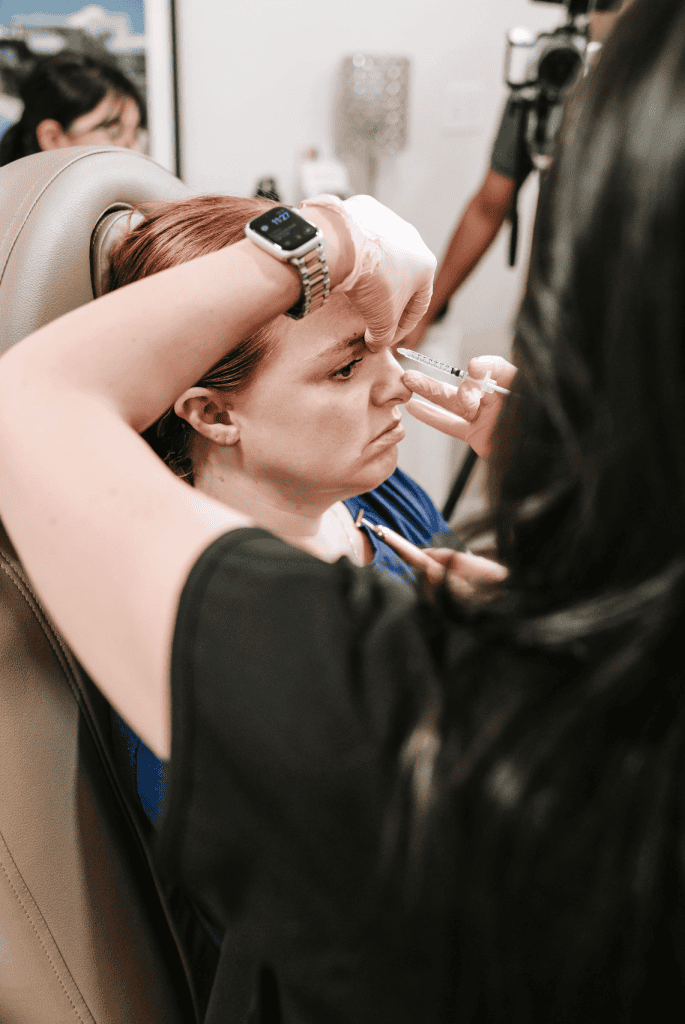
Hands-on quality comes down to ratio, not just repetition. Courses that cap class size at a low instructor-to-student ratio, ideally 1:6 or lower, allow real-time correction of injection angle, depth, and dosing. Larger classes force students to watch more than they inject.
Does In-Person Training Beat Online-Only Courses?
In-person nurse injector training gives clinicians something online modules cannot: live full-face practice under supervision. Access to injection maps reinforces proper site selection while an instructor observes technique directly.
Before committing to a course, compare options against this checklist:
- Does the curriculum include dermal filler training alongside neuromodulator instruction?
- Is the instructor-to-student ratio 1:6 or smaller?
- Does the course offer 1:1 full-face hands-on practice?
- Are injection maps and anatomy references provided for ongoing reference?
Professionals researching how to get trained in botox should treat class size. Live practice time as non-negotiable filters, not optional perks. A course that checks every box above builds the confidence needed for safe, independent injecting from day one.
How Do You Earn CE Hours And Certification?
Continuing education (CE) hours accrue through structured, pre-approved coursework rather than casual observation shifts. Licensed professionals earn 6.35 CE credits through in-person botox training that carries pre-approval from the AANP, giving nurse practitioners a direct route to satisfy licensure renewal requirements while building injection skill. Weekend-intensive formats push that total higher: some programs deliver 11.35 CE credits across a single weekend by combining full-face Botox injection technique with Dermal Filler training. That structure matters for professionals juggling clinical shifts who need concentrated, high-yield education rather than a semester-long commitment.
Earning certification follows a defined sequence:
- Confirm state-specific scope-of-practice rules, since requirements differ for RNs, NPs, PAs, and MDs depending on jurisdiction.
- Enroll in a course offering pre-approved CE credit, verifying hours align with licensing board expectations.
- Attend hands-on training that pairs didactic instruction with live-model injection practice.
- Receive a course manual and injection materials, including botulinum toxin A, supplied as part of the curriculum.
- Complete post-course assessment and retain documentation for state board or employer verification.
Do CE requirements differ by state?
Yes. Certification processes and renewal requirements shift from state to state. What satisfies a New York board may not satisfy another jurisdiction. RNs, NPs, PAs, and MDs should verify their specific state’s continuing education mandates before selecting a course. aesthetics training providers structure CE hours to match common licensing frameworks but cannot override individual state board rules.
What’s included in a hands-on certification course?
Reputable dermal filler training and Botox programs supply a course manual alongside all injection materials needed for live practice. Botulinum toxin A is typically not included and students inject under supervision using saline as there is a 2-week waiting period for the drug to take effect.
How Do You Practice Legally In Your State?
Legal practice depends entirely on the state issuing the license. Nurses, physician assistants, and physicians each face different scope-of-practice rules, and skipping this research costs clinicians their license or worse. New York’s 2025 regulatory framework, for example, spells out distinct requirements for nurses and physicians across urban markets like New York City and Albany. Well as smaller regional practices. Texas takes an even stricter stance: administration of Botox and dermal fillers stays limited to medical professionals who complete a recognized certification program.
Who Is Legally Allowed to Inject Botox?
Eligibility varies by state, but Texas offers a clear model. Dentists, licensed physicians, nurse practitioners, registered nurses, and physician assistants may all inject Botox once they finish an approved certification course. Completing botox training doesn’t override state licensing boards. Professionals still need to confirm their scope of practice before booking their first client.
How Should Professionals Confirm Their State’s Rules?
- Contact the state medical or nursing board directly to verify scope-of-practice language for injectables.
- Confirm whether physician oversight or delegation agreements are required for NPs, PAs, or RNs.
- Complete accredited aesthetics training that includes both Botox and dermal filler training components.
- Document certification credentials for malpractice insurance and med spa employment applications.
- Review state-specific renewal or continuing education requirements annually.
Injectables EDU supplies a complete guide to launching a Botox-focused practice, paired with state-specific resources for professionals figuring out how to get trained in botox the right way. That guidance, combined with hands-on nurse injector training, helps clinicians build a compliant, confident practice. No matter which state issues their license.
What Mistakes Should New Injectors Avoid?
New injectors most often fail by rushing past foundational education. Skipping thorough botox training on facial anatomy, dosing, and injection technique creates real safety risks and damages a provider’s standing with clients before a practice even gets off the ground. A face is not forgiving of guesswork, and neither are patients.
Class size matters more than most new injectors realize. Large, crowded courses limit the hands-on repetition needed before working independently. Low-ratio aesthetics training gives each participant direct feedback from an instructor. Programs capping groups at 12 students, with roughly one instructor per six trainees, allow real skill-building instead of passive observation.
Does training end after the initial course?
It shouldn’t. New injectors frequently make the mistake of treating certification as a finish line rather than a starting point. Ongoing mentorship and compliance guidance after nurse injector training help providers navigate real client cases, troubleshoot complications, and grow a practice with confidence instead of guesswork.
What technical details do untrained injectors overlook?
Storage, preparation, and dilution protocols for botulinum toxin get overlooked constantly. Weak programs rush past these steps, leaving providers unsure how to reconstitute product correctly. Anyone researching how to get trained in botox. Pursuing dermal filler training, should confirm these protocols are taught explicitly, not glossed over.
FAQ
Who is eligible for Botox certification?
Registered nurses, nurse practitioners, physician assistants, and physicians with an active, unrestricted license qualify. Candidates must confirm their license type permits injecting in their practice state, since scope-of-practice rules vary.
How much does Botox certification cost?
Basic Botulinum Toxin Certification is a comprehensive one-day course that includes hands-on practice with experienced physician instructors. Pricing varies by package, so contact Injectables EDU directly for current rates.
Where does Injectables EDU offer Botox training?
Injectables EDU, headquartered in Richmond, VA, offers Botox and filler courses nationwide and online. Courses include continuing education credit from AANP for qualified healthcare practitioners.
Disclaimer
This article is provided for general educational purposes only and does not constitute legal, medical, or licensing advice. Certification requirements, scope-of-practice rules, and continuing education standards vary by state and change over time; readers should verify current requirements with their state medical or nursing board before enrolling in training or administering injectables. Injectables EDU makes reasonable efforts to keep this information accurate and current but does not guarantee its completeness or applicability to any individual’s circumstances. For specific guidance, contact Injectables EDU directly at info@injectablesedu.com.