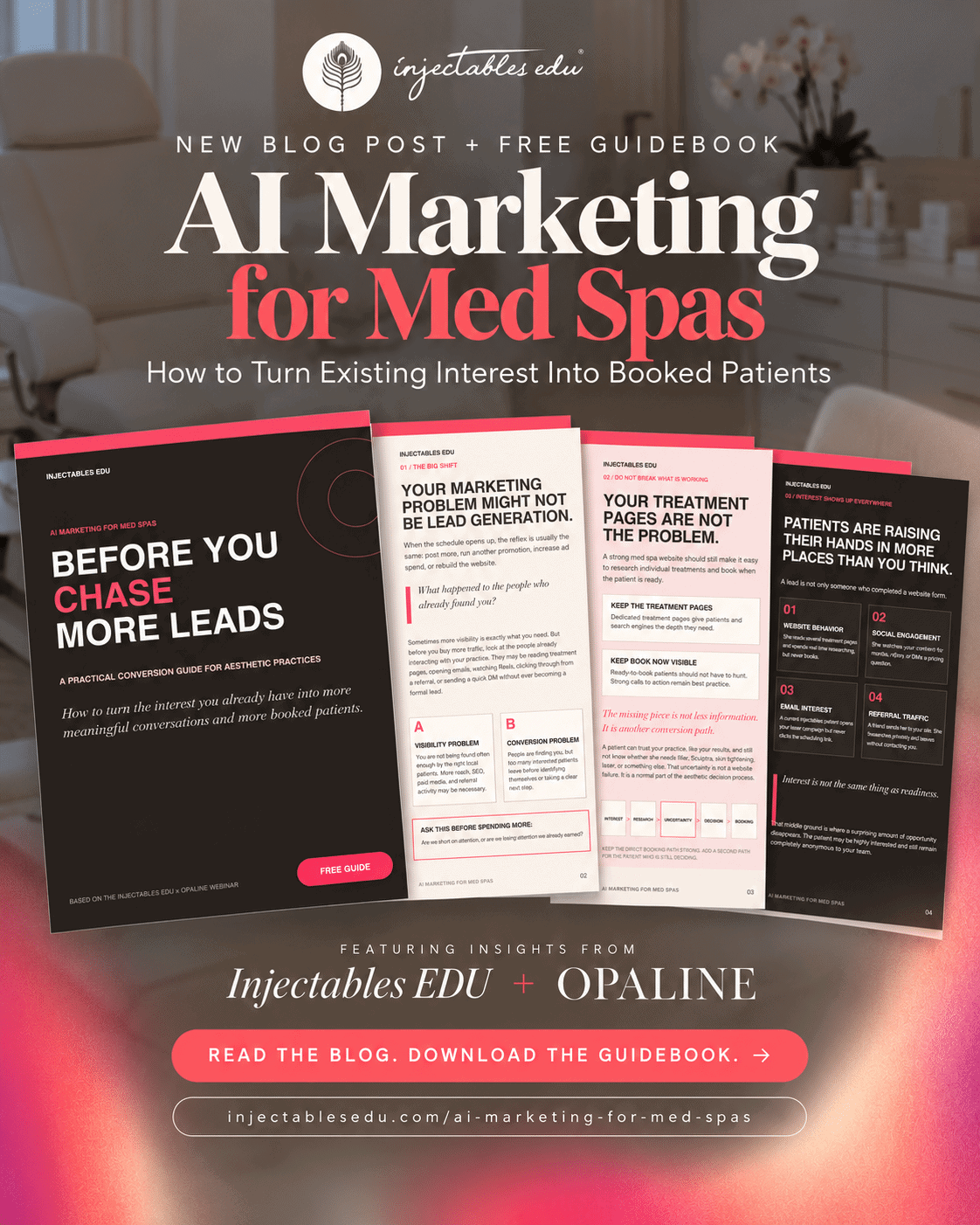
When the schedule gets a little too open, most aesthetic practice owners have the same reaction: we need more leads. So you post more often, create a promotion, boost something on Instagram, increase your ad budget, or start wondering whether your website needs another overhaul.
Sometimes more visibility really is the answer. But sometimes it is not.
Before you spend more money trying to get another hundred people to find your practice, there is a more important question to ask: What happened to the people who already found you?
That was the conversation behind our recent Injectables EDU webinar with Opaline, where Suzanne Jagger and Cassie Lane of Injectables EDU joined the Opaline team to talk about how AI can actually be useful inside an aesthetic practice.
Not AI because it is trendy. Not another chatbot because someone told you your website needs one. And definitely not a robot replacing the patient-provider relationship.
We talked about something much more practical: using technology to better understand what prospective patients want before they are ready to book, then creating a clearer path from interest to appointment.
Imagine someone discovers your practice on Instagram. She watches a Reel about Sculptra, clicks through to your profile, and visits your website. She likes your results, trusts what she sees, and starts researching.
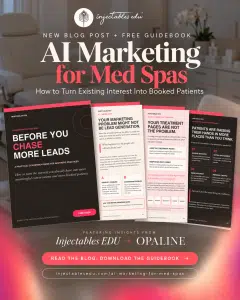
Watch the full AI Marketing for Med Spas webinar replay on YouTube and be sure to DOWNLOAD THE FULL GUIDEBOOK
The Med Spa Marketing Problem Might Not Be Lead Generation
A strong med spa website should make it easy for patients to research individual treatments and book when they are ready. Dedicated treatment pages are important for both the patient experience and search visibility, and clear BOOK NOW calls to action should appear throughout the site.
But not every person who lands on your website has reached that point in the decision process.
Maybe she reads your Sculptra page. Then she looks at filler. Then skin tightening. She knows what bothers her, but she still is not sure which treatment actually makes sense for her goals.
That does not mean your treatment pages are not working. In fact, they may be doing exactly what they are supposed to do by educating her, building trust, and helping your practice appear when patients search for those services.
The opportunity is what happens in addition to BOOK NOW for the patient who is interested but not quite ready to schedule.
If her only next step is to keep researching or make an appointment she does not yet feel prepared to book, she may leave without ever identifying herself to the practice. From your side of the business, she remains an anonymous website visitor even though she may have been a highly interested future patient.
That is the gap we are talking about.
The goal is not to replace treatment pages, reduce booking calls to action, or make it harder for ready-to-book patients to schedule. It is to create an additional path for the people sitting between “I am interested” and “I know exactly what I want, and I am ready to book.”
Your Patients Are Raising Their Hands in More Places Than You Think
One of the biggest mistakes in med spa marketing is thinking of a “lead” as someone who completed a website form.
Interest can show up almost anywhere. A potential patient visits your website and reads three treatment pages. Someone sends an Instagram DM asking, “How much is Botox?” A former patient texts about a treatment she saw on your Story. A friend refers someone who visits your website but never schedules. A longtime injectable patient opens an email about laser treatments but does not click BOOK NOW.
Someone may even follow your practice for six months before ever contacting you.
All of these people are somewhere between curious and ready, and that middle ground is where aesthetic practices can lose a tremendous amount of opportunity.
The traditional digital patient journey often asks someone to make a large jump:
See something interesting → research treatments → choose a service → schedule an appointment.
For patients who already know what they want, that journey works very well.
But that is not how every patient makes a decision, especially in aesthetics.
Patients research. They compare. They look at before-and-afters. They ask friends. They wonder about cost. They worry about looking overdone. They try to figure out which treatment matches the concern they see in the mirror.
A potential patient may know exactly what bothers her while having absolutely no idea what treatment she needs.
That is a very different problem from lack of interest.
“Book Now” Should Be Easy, But It Does Not Have to Be the Only Next Step
Online booking is important. If someone is ready to schedule, you should make that path extremely easy.
Your website should have strong calls to action. Your treatment pages should lead patients toward booking. Your navigation should help people quickly find the services they are researching.
But what about the person who is interested and still deciding?
This is where an additional conversion path can become valuable.
A patient might land on a website offering Botox, filler, Sculptra, lasers, microneedling, RF microneedling, chemical peels, facials, wellness services, and several other treatment options. That depth is good. It gives Google and prospective patients meaningful information about what the practice offers.
The challenge is simply that the patient is still responsible for figuring out which of those options applies to her.
That works beautifully for the person who already knows, “I get 40 units of tox every four months and I need my next appointment.”
It works differently for the person thinking, “My face looks tired lately and I do not know why,” or, “I want my skin to look better before my daughter’s wedding,” or, “I have lost weight and suddenly feel like my face aged ten years.”
Those patients may not need more treatment information as much as they need help organizing the information they already found.
A stronger patient journey can give them another way to engage before they are ready to schedule. That might be an assessment, treatment finder, quiz, or other guided experience that starts with the patient’s concern and helps point her toward a logical next step.
It does not replace your website strategy.
It adds another conversion opportunity to it.
Where AI Can Actually Help a Med Spa
AI gets pitched to aesthetic practices constantly, and plenty of owners have understandably started tuning it out.
Put an AI chatbot on your website. Have AI write all your captions. Automate everything. Let AI answer every question.
That is not necessarily where the biggest opportunity is.
One of the most useful applications of AI in med spa marketing is actually narrower: helping practices understand patient intent earlier in the decision process.
During the webinar, we walked through how Opaline approaches that problem. A prospective patient can enter through the website, social media, a text, an email campaign, or another marketing channel and complete a guided assessment.
Instead of simply giving the practice a name and phone number, that interaction can reveal useful context such as:
- What the patient is concerned about
- What she wants to improve
- Her treatment experience
- What types of solutions she may be interested in
- Where she is in the decision process
The patient gets education and a clearer starting point. The practice gets something much more valuable than another anonymous website visit.
You know what she raised her hand for.
That changes the follow-up conversation.
Instead of, “Hi, we saw you filled out our form. Would you like to schedule a consultation?” your team can begin with context. You already have a better understanding of what she wants to talk about.
That is where AI becomes less about replacing human interaction and more about making the human interaction better.
Good AI Should Support Clinical Judgment, Not Pretend to Replace It
This point is especially important in medical aesthetics.
An online tool should not be pretending to provide a definitive treatment plan or guarantee an aesthetic outcome. There are things technology cannot fully understand without an actual provider assessment, including anatomy, treatment history, tissue quality, medical history, facial movement, healing response, and the clinical judgment of an experienced injector or aesthetic provider.
The goal is not to remove the consultation. The goal is to make the journey to that consultation more useful.
Think of it as patient discovery.
Someone can explore concerns, learn about possible options, and become more educated before sitting down with the provider. Then the actual treatment recommendation still happens where it belongs: between the patient and a qualified medical professional.
For practices, this can also create a better consultation. Rather than spending the beginning of the appointment figuring out why someone came in, the provider has more context from the start and can spend more time educating, assessing, and building the appropriate treatment plan.
Before You Build More Marketing, Strengthen the Foundation
This is also where the broader marketing strategy matters.
At Injectables EDU, we have talked for years about building your marketing in the right order. Your website and digital foundation matter because nearly everything eventually points back to them.
Social media sends people to your website. Google sends people to your website. Ads send people to your website. Emails send people to your website. Events send people to your website. Referrals Google you and visit your website.
That means a well-built website, strong service pages, local SEO, clear navigation, helpful treatment information, social proof, and strong booking calls to action are not optional pieces of your marketing.
They are the foundation.
Once that foundation is working, the next question becomes: Are we capturing as much intent from that traffic as we reasonably can?
Posting every day will not fix a confusing website. More ad spend will not fix poor follow-up. A patient assessment cannot compensate for weak treatment content or a website that does not build trust.
On the other hand, a beautifully built website cannot identify every interested person who browses and leaves without taking an action.
These pieces work together.
Your website earns visibility, answers questions, builds trust, and creates the path to booking. An additional discovery tool can help capture some of the people who are interested but have not yet crossed the line into scheduling.
That is a much stronger marketing system than asking any one channel or tool to do everything.
A Real Med Spa Example: Selling More Without Finding a Brand-New Audience
One example discussed during the webinar came from Luxe Posh Place.
Owner Jen Romero-Anderson had already built a patient base of roughly 600 people, many of whom primarily knew the practice for injectable treatments. Then the practice invested in new technology and treatment modalities.
This created a very common med spa problem.
The audience was already there. The trust was already there. The patients simply did not know everything the practice could now do for them.
Instead of assuming the answer was immediately finding hundreds of brand-new people, Luxe Posh Place used a personalized treatment quiz on its website and promoted the experience to its existing audience on Instagram.
Patients learned about treatment options based on their concerns, while the practice learned who was actually interested in those new services.
According to Opaline’s case study, the campaign resulted in 34 new leads booked within three months, with $47,600 in projected patient lifetime revenue and a 53x projected return on the Opaline investment.
The revenue and return figures are projections, which is an important distinction, but the larger marketing lesson is the part worth paying attention to.
They did not start by finding an entirely new audience.
They started with the audience they had already earned.
Smaller Med Spas Should Pay Even More Attention to Conversion
It is easy to assume technology like this makes the most sense for a large med spa with thousands of website visitors.
There is an argument for the exact opposite.
If you are a solo injector and only receive 12 serious inquiries this month, losing three of them matters. A lot.
You may also be the person treating patients, answering Instagram DMs, returning texts, managing inventory, creating content, and attempting to eat lunch sometime before 4:00 p.m.
You do not have unlimited time to chase vague inquiries, and every consultation that begins from zero takes more of your time.
For a smaller practice, better qualification and better follow-up are not just marketing improvements. They are operational improvements.
Your goal is not to automate away the personal relationship that helped you grow the practice in the first place. Your goal is to use technology where it can remove friction, surface useful information, and help your team spend more time having meaningful conversations with the right people.
Your Existing Patient List May Be Your Most Undervalued Marketing Asset
Another important takeaway from the conversation is that acquisition gets a tremendous amount of attention, but your past patients already know you.
That makes them an incredibly valuable audience.
Think about how many practices continuously market Botox to the same Botox patients while quietly adding lasers, skin treatments, regenerative treatments, hormone services, weight management, body treatments, hair restoration, new devices, and memberships.
Your patients cannot buy something they do not know you offer.
And an email saying, “We now offer XYZ laser!” may not mean much to a patient who has no idea what XYZ laser does.
Instead, start with her problem.
What would you like to improve? What has been bothering you? What result are you trying to achieve?
That creates an entirely different conversation.
The marketing shifts from:
Here is another thing we sell.
To:
Tell us what you want help with and let us show you where to start.
That is more useful for the patient and much more informative for the practice.
The Best Med Spa Marketing Technology Should Tell You Something Useful
Before adding another piece of software to your practice, ask what information it gives you that you do not already have.
A tool that gives you more website traffic is useful if traffic is the problem. A tool that generates more leads is useful if lead volume is the problem. A better website is important if the current site is difficult to use, does not rank well, lacks important treatment content, or fails to build trust.
But if you already have traffic, inquiries, followers, a strong website, and a patient database, another acquisition tactic may not solve the actual constraint.
You may need better insight into questions like these:
- Who is interested?
- What are they interested in?
- Where did they stop?
- Who needs follow-up?
- What are existing patients curious about next?
- Which services have demand you are not currently seeing?
- Where are people hesitating before booking?
Good technology should reduce uncertainty. It should help your team make a better decision or have a better conversation.
If all it gives you is another dashboard full of numbers nobody has time to look at, congratulations. You bought another dashboard.
Do This Before Spending Another Dollar on Leads
You do not need new software to begin evaluating this problem. Start with a simple lead audit.
1. Count every person who raised a hand last month
Do not count website visitors as inquiries. Count the people who actually took an identifiable action.
Look at website forms, phone calls, texts, Instagram DMs, Facebook messages, consultation requests, and any other channel where someone actively expressed interest.
Most practices cannot immediately answer this number.
That alone tells you something.
2. Find out what happened to them
How many booked? How many were contacted? How quickly were they contacted? How many never responded? How many did your team follow up with more than once? How many asked a question and disappeared? How many simply got lost?
You cannot improve a conversion rate you are not tracking.
3. Look at the gap between curiosity and BOOK NOW
Now go through your marketing like a patient.
Assume you are interested, but you are not ready to schedule yet.
Can you easily research the treatment? Can you see results? Can you understand the provider’s credentials? Can you find pricing information if the practice shares it? Can you move quickly into booking if you are ready?
Then ask the next question.
If you are not ready to book, is there another meaningful way to engage?
Can you explore based on your concern? Can you get guidance about where to start? Can you raise your hand without committing to an appointment?
The goal is not to weaken the direct path to booking.
The goal is to add a useful path for the people who are not quite there yet.
Ready to get started? Book a demo with Opaline! BOOK CALL HERE: https://joinopaline.com/injectables-edu/
Frequently Asked Questions About AI Marketing for Med Spas
How can med spas use AI for marketing?
AI can support med spa marketing by helping practices understand patient interests, personalize education, identify intent, organize lead information, and improve follow-up. The most valuable uses often support the patient journey rather than simply generating more marketing content.
Can AI help a med spa get more patients?
AI can help practices convert more existing interest into consultations by creating better discovery and follow-up experiences. It should not be viewed as a magic replacement for a strong website, good SEO, effective marketing, excellent patient care, or a trained team.
Does a med spa always need more leads to grow?
No. Some practices genuinely need more visibility and lead generation. Others already have significant traffic, inquiries, followers, or past patients but may be losing opportunities between initial interest and booking.
Tracking inquiry-to-consultation performance helps determine which problem you actually have.
Does a med spa still need individual treatment pages?
Yes. Dedicated treatment pages help patients research services and can give search engines clearer information about the treatments your practice offers. A strong website should provide useful, in-depth treatment information while also making booking easy for patients who are ready.
A patient discovery or assessment tool serves a different purpose. It can provide another path for visitors who know what they want to improve but are not yet sure which treatment to choose.
Should a med spa use an AI chatbot?
It depends on what the chatbot actually does.
A generic chatbot that provides canned answers may add little value. A structured tool that helps patients explore concerns, understand options, and clearly communicate their intent to the practice can serve a much more useful role.
Can AI recommend aesthetic treatments?
AI can help educate patients and surface possible treatment categories, but final treatment recommendations should remain with qualified providers who can evaluate the patient’s anatomy, medical history, goals, and individual needs.
What should a med spa track before increasing its marketing budget?
At minimum, track how many inquiries you receive, where they originated, response time, how many convert to consultations, how many consultations convert to treatment, and where prospective patients drop out of the process.
More traffic becomes much more valuable when the practice has a reliable system for converting the interest it already receives.
The Bigger AI Marketing Opportunity Is Not More Noise
The aesthetics industry does not need more marketing noise.
Patients already have endless Reels, before-and-afters, promotions, Google results, treatment names, and opinions coming at them.
The bigger opportunity is making the decision process easier.
Build the treatment pages. Strengthen your SEO. Make BOOK NOW impossible to miss. Show your results. Explain your services. Build trust.
Then look at the people who are interested but still hesitating.
Help them understand what might fit their goals. Give curious people a next step before they are ready to book. Capture meaningful intent instead of only contact information. Follow up with context.
Use technology to make your team more informed, not less human.
And before you automatically decide your practice needs more leads, find out what happened to the ones you already had.
Because the person who never booked may not have needed another ad.
She may have simply needed a better path forward.
Watch the Full Webinar: AI Marketing That Actually Works
Want to see the full conversation and the patient experience in action?
In this Injectables EDU webinar with Opaline, we dig deeper into where potential patients can fall out of the booking journey, how AI can support patient discovery and qualification, and how aesthetic practices can get more value from the audience and traffic they have already built.
Then take one action this week: before you spend more money finding new people, count the people who already raised their hands.
Ready to get started? Book a demo with Opaline! BOOK CALL HERE: https://joinopaline.com/injectables-edu/